

As tensions with Iran increase, put perspective over panic
Financial markets have weathered many global shocks
5 min read
KEY POINTS
- Geopolitical events often feel alarming in real time, but markets historically recover as fundamentals reassert themselves.
- The stock market’s reaction to the recent escalations with Iran has been modest compared with past shocks.
- With economic momentum still intact, a disciplined long term investment approach remains the most effective guide through uncertainty.
It’s understandable to feel a sense of concern right now. Headlines and updates from Iran are becoming increasingly serious as hopes for a quick de-escalation fade, Iran’s response broadens and the Strait of Hormuz—a critical chokepoint for global oil and natural gas—appears effectively closed. Higher oil prices are already showing up at the pump and raising new questions about the path of inflation, interest rates and economic growth. Concern is a natural reaction when global risks rise.
However, concern and reacting out of fear are not the same thing. From an investment perspective, history offers a broader and steadier lens than today’s news cycle. Our chart this week tracks a wide range of geopolitical events dating back to World War II. As I look at this long list, I’m reminded how many of these moments felt uncertain or alarming in real time. Yet in most cases, markets recovered as the underlying economic fundamentals reasserted themselves.
In fact, the stock market has shown notable resilience so far amid the news out of Iran. Compared to past geopolitical shocks, the current market move has been relatively modest. Could additional negative developments lead to more volatility? Certainly. However, historically, as time passes after an event, the probability of market recovery increases—sometimes significantly.
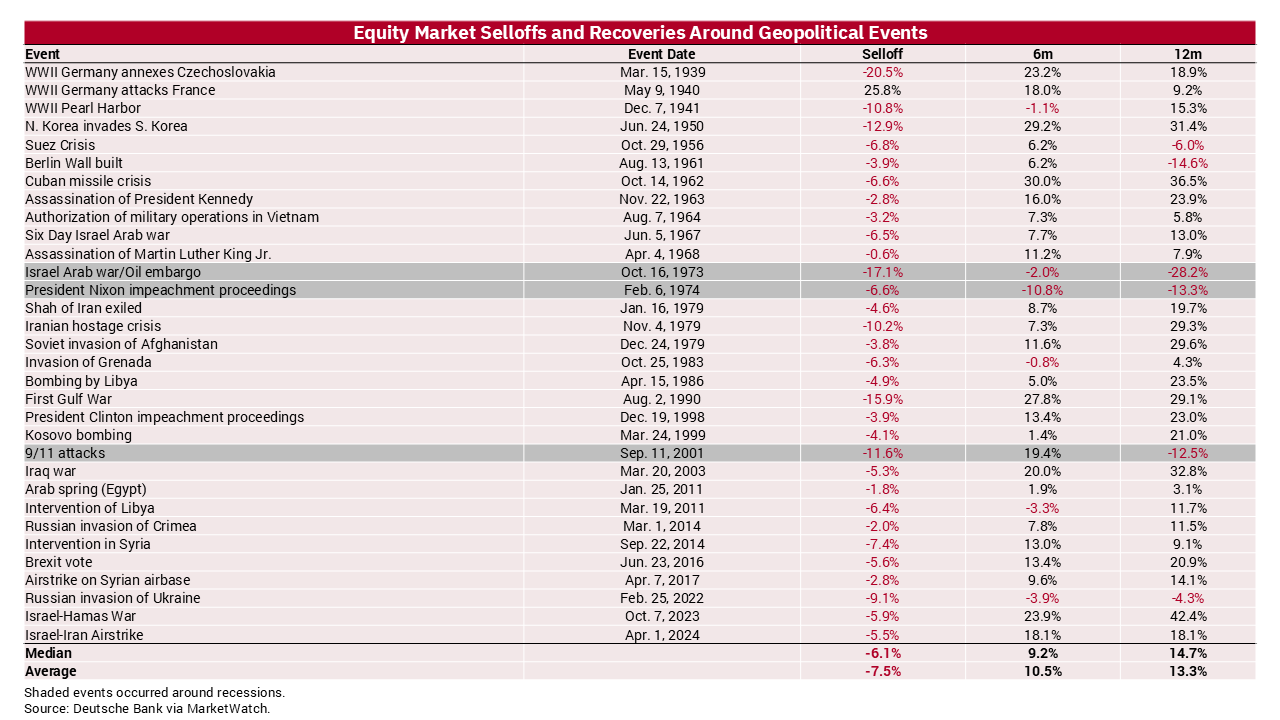
There are three notable exceptions in the chart: periods where markets were still down 12 months after the event. In each instance, the geopolitical shock occurred during or near a recession. That context matters.
Looking at the current environment, gross domestic product (GDP) growth was positive last year, and several indicators suggest the domestic economy is showing signs of improvement. Elements of the One Big Beautiful Bill Act (OBBBA) support both consumer and corporate activity, and unemployment remains relatively low at 4.4%. At the same time, challenges remain: job growth turned negative in February, inflation is still above the Federal Reserve’s 2% target and sustained higher energy prices could make rate cuts more difficult.
Even so, the overall momentum in the economy provides a foundation for cautious optimism.
We all hope this conflict moves toward resolution more quickly than current reports suggest. The human toll is heartbreaking, and global risks are rising. Concern is natural in moments like this. Yet, when it comes to the markets, our disciplined approach keeps us focused on the long-term objectives of our clients, the strength of our process and the historical perspective that helps us navigate uncertain periods with clarity and confidence.
Get By the Numbers delivered to your inbox.
Subscribe (Opens in a new tab)